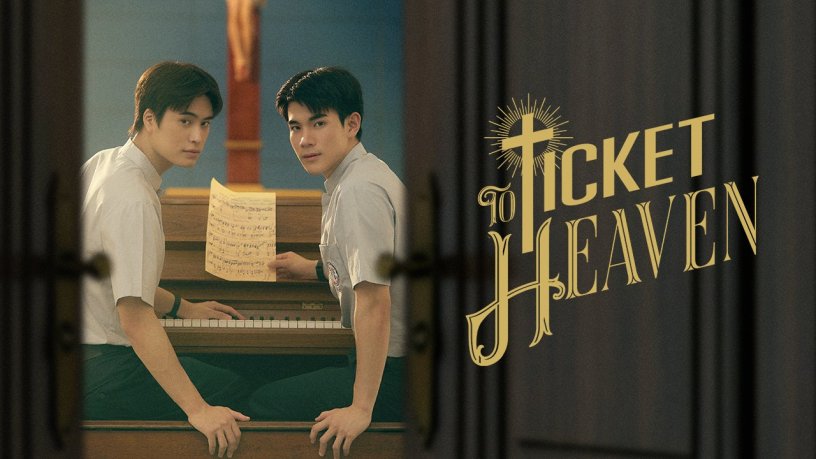
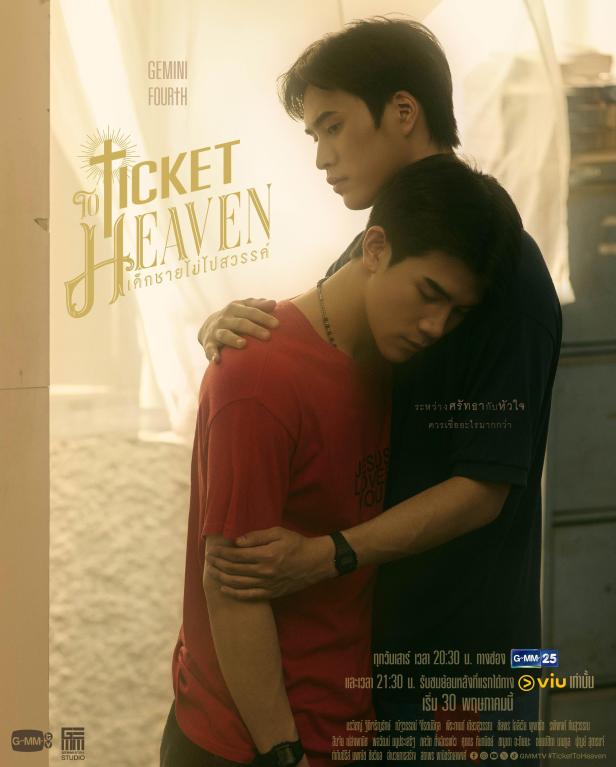
One of the most anticipated GMMTV series of 2026 is Ticket to Heaven. Written by Noppharnach Chaiyahwimhon (Aof) and Kittisak Kongka (Best) – the series isn’t based on previous works, but rather common stories and experiences by young people within the church. Set in 1996, the series follows Tanrak, a deeply religious student training for the priesthood who believes dedicating his life to God will be the key he needs to earn his place in heaven to reunite with his parents. However, those convictions are challenged when he meets Barth, a rebellious new student whose presence awakens feelings and questions Tanrak has spent his life trying to suppress. As their bond deepens, both young men are forced to confront the difficult intersection of faith, identity, love, and the expectations placed upon them by the world around them.
In order to understand the gravitas of this series, it is important to remember that 1996 was a very different world from the one many LGBTQ+ young people inhabit today. While Thailand is often perceived internationally as one of Asia’s more tolerant societies, tolerance and acceptance have never been the same thing. Public visibility for queer people certainly existed, particularly through entertainment and the visibility of kathoey communities, but young gay men still grew up in a culture where heterosexuality was considered the expected path. Family duty, social reputation, and religious values often carried tremendous weight, leaving many teenagers struggling to reconcile who they were with who they were expected to become.
For students attending religious schools, these pressures were often even more intense. Adolescence is already a period defined by uncertainty. Our bodies, our minds, and hearts are expanding. This expansion leads to questions, desires, and exploration. But within institutions built upon moral expectations and rigid social structures, questions surrounding sexuality were oftentimes met with ridicule, or worse silence.
Many young men learned to compartmentalize these confusing emotions, convincing themselves that attraction was merely a phase – a temptation meant to steer them away toward something evil and would dissipate if it was repressed enough. It rarely did. Instead, those feelings often manifested as loneliness, self-doubt, and the painful belief that being loved for who they truly were would lead to eternal damnation.
It’s a story many young people can relate to, no matter where they are from. Though separated by more than two decades, Ticket to Heaven invites easy comparison to the cult Off-Broadway pop opera Bare. Set within a Catholic boarding school, with lyrics by Jon Hartmere and music by Damon Intrabartolo, Bare follows two young men who are forced to conceal their relationship beneath the expectations of family, faith, and institutional authority. The musical explores how religion, shame, and the fear of rejection can shape a young person’s sense of self, asking whether love and faith can coexist when the world insists they cannot. Its themes of secrecy, internalized guilt, and the desperate desire to be seen resonate strongly with the emotional landscape that Ticket to Heaven appears poised to explore.
My love of Bare is one of the reasons I was so excited for this series. The other is its leads, Norawit Titicharoenrak (Gemini) and Nattawat Jirochtikul (Fourth). Having interviewed the pair during the launch of their breakthrough series My School President, I’ve been fortunate enough to witness their chemistry and charisma firsthand. They remain two of my favorite performers working in the genre today, making Ticket to Heaven one of my most anticipated releases of the year.
Episode One begins in the present day with Barth returning to St. Magdalene College. However, the audience is quickly transported back to 1996, when he first arrived as an angry young man carrying more baggage than the suitcase in his hand and seemingly ready to fight anyone who looked at him the wrong way. From there, the series carefully lays the foundation for the emotional journey ahead as Barth’s arrival begins to disrupt the carefully ordered world around him.
Episode Two begins building the emotional storm. As Tanrak and Barth spend more time together, their growing connection becomes increasingly difficult to ignore, creating a tension that lingers beneath even the simplest interactions. What starts as curiosity slowly develops into something deeper, leaving both young men to wrestle with feelings neither fully understands nor knows how to express.
Fourth delivers a beautifully restrained performance as Tanrak, capturing the quiet devotion and innocence of a young man who genuinely believes faith can provide all the answers he seeks. Gemini, meanwhile, effortlessly balances Barth’s rebellious exterior with glimpses of the vulnerability hidden beneath the surface. As always, director Aof Noppharnach Chaiyahwimhon handles the material with remarkable sensitivity, balancing the series’ heavier themes with moments of warmth and humanity to create a premiere that feels thoughtful, authentic, and emotionally resonant.
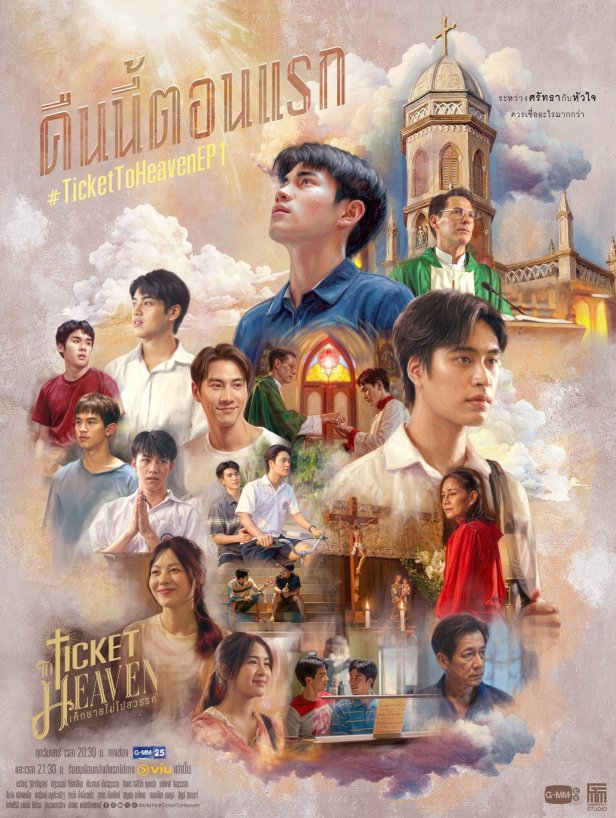
Rich with emotion, Ticket to Heaven promises to be the most compelling series from these two young actors yet. I can’t wait to see how its story unfolds. You can stream the series via GagaOOlala with new episodes uploaded every Saturday.
There will be more Ticket to Heaven soon so…
Stay Tuned.

