
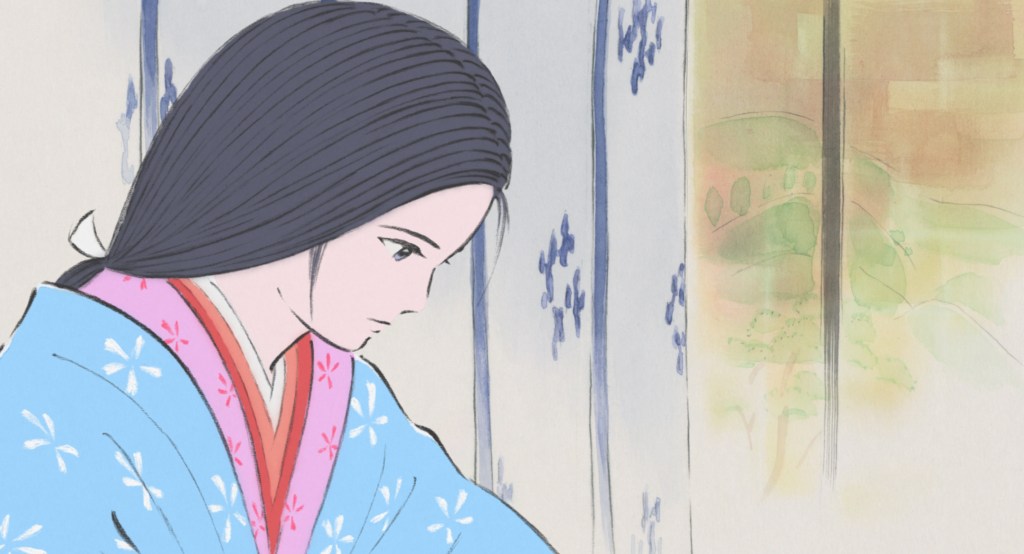
Princess Kaguya is one of the most famous characters in Japanese literature. The Tale of the Bamboo Cutter was during the Heian period ( late 9th or early 10th century). While its author is unknown, it is considered the oldest surviving work in the Monogatari form. It’s a beautiful story and one of my favorite fairytales of all time – and the Studio Ghibli adaptation is one of the most beautiful I have ever seen.

Co-written by Riko Sakaguchi and directed by the late Isao Takahata, the film not only received critical acclaim but was also nominated for Best Animated Feature at the 87th Academy Awards, a testament to its exceptional quality. This was the final directorial work of Takahata, known for his masterpieces such as Grave of the Fireflies, Only Yesterday, and My Neighbors the Yamadas.
One day, a bamboo cutter, Sanuki no Miyatsuko, discovers a tiny girl inside a glowing bamboo shoot. Believing her to be some sort of divine being, he and his wife take her in, raising her as if she were their own child – and soon discover that magic surrounds her. Calling her “Princess,” the little girl grows rapidly, which earns her the nickname Little Bamboo from the village children. One in particular, Sutemaru, the oldest among them, develops a close and protective relationship with her.
When she comes of age, the bamboo cutter takes her to the capital and she is given the formal name “Princess Kaguya.” A celebration is held, where Kaguya overhears partygoers ridiculing her father’s attempts to turn a peasant girl into a noble woman through monitary means. Upset, Kaguya leaves the party and rushes back to the mountains, seeking Sutemaru and her other friends. However, all moved away – and Sutemaru has gotten married and has a child. While she never forgot her feelings for him, she realizes that time has moved on without her and there’s no escape from this new life.

As she continues to grow in status – and in beauty, five noblemen attempt to court her, comparing her to mythical treasures. Kaguya tells them she will only marry whoever can bring her the mythical treasure mentioned. None of them can fulfill the quest.
Eventually, Kaguya reveals to her parents her origin in the kingdom of the Moon. Once a resident there, she broke its laws, hoping to be exiled to Earth so that she could experience mortal life. But, when the Emperor makes romantic advances toward her, she begs the Moon for help. Hearing her prayer, the Moon restores her memories and promises reclamation at the next full Moon.
Expressing her attachment to Earth and her reluctance to leave her loved ones, the bamboo cutter swears to protect her and turns their large home into a fortress. But it’s no use. On the night of the full Moon, a procession of celestial beings led by the Buddha himself descends from the Moon.
An attendant offers Kaguya the robe that will erase her memories of Earth. After embracing her family one last time, she wears the robe. The celestials leave, taking Kaguya with them – leaving the bamboo cutter and his wife distraught.
The score, composed by Joe Hisaishi, is one of his best. A sweeping epic of sound, it fits so perfectly with the film.

The Tale of Princess Kaguya has seen several releases to home media, including a collectible steel book release through Shout Factory / Gkids. With an aspect ratio of 1.85:1, the film, clocking in at about 137 minutes is presented in glorious HD. The set includes audio presented in the original Japanese as well as English, and French each with Dolby Digital 5.1 surround sound. Extras include:
- Exclusive Booklet
- Feature-Length Documentary Isao Takahata and His Tale of the Princess Kaguya
- Announcement of the Completion of the Film
- Trailers & TV Spots
Currently available through Shout Factory, GKids, and Amazon, once the set is sold out, it’s gone… so act fast!
More Studio Ghibli films soon so…
Stay Tuned!
 Life In Cartoon Motion