
I didn’t know what to expect walking into Guillermo del Toro’s Frankenstein. The creature, while iconic, was never one of “my” monsters. I’ve always been more of a vampires-and-werewolves kinda guy. So I braced myself for madness, mystery, terror — the usual gothic theatrics.
What I got instead was the blooming of a beautiful gothic tapestry, stitched from shadow, sorrow, and silver-blue light.
Del Toro’s adaptation is tragic, breathtaking, and intensely human.
As a storyteller, del Toro has always had a painter’s eye, but with Frankenstein he ascends into an entirely new realm. Every frame feels hand-brushed, built from a palette of bruised blues, funereal greys, and golds that look stolen from cathedral icons — yet it never once tips into self-indulgence. There is beauty in the grotesque, in the broken, in the stitched-together miracle that should never have lived… and somehow pulls at the heartstrings anyway.
Which brings me to Jacob Elordi.
Fragile, naïve, and yes, at times terrifying, his Creature is deeply and painfully human. Elordi plays him not as a monster, but as a newborn soul trapped in a body he did not ask for — aching for the love of his creator. You feel his loneliness. His confusion. His desperate desire to be seen by a world that recoils from him. Del Toro gives the Creature dignity and mythic weight; Elordi gives him vulnerability and impossible empathy.
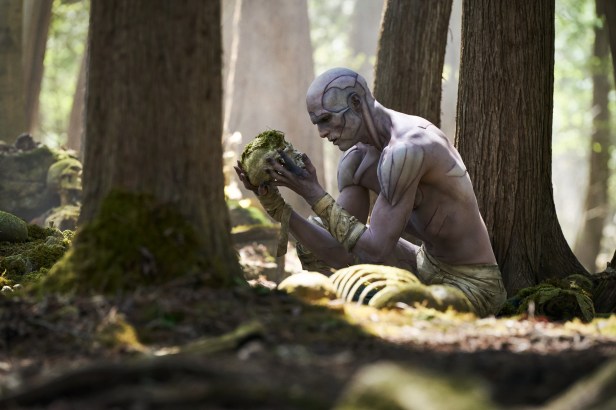
Oscar Isaac, meanwhile, brings a chilling complexity — and an innate, simmering sensuality — to Victor Frankenstein. His Victor isn’t a madman or an untouchable genius; he’s a man undone by ambition, grief, and the seductive promise of playing God. Isaac’s brilliance is in the restraint: he plays Victor as someone who knows he has crossed a line but keeps walking anyway. And del Toro leans into the tragedy of their bond: two beings linked by lightning, betrayal, and the echo of what might have been.
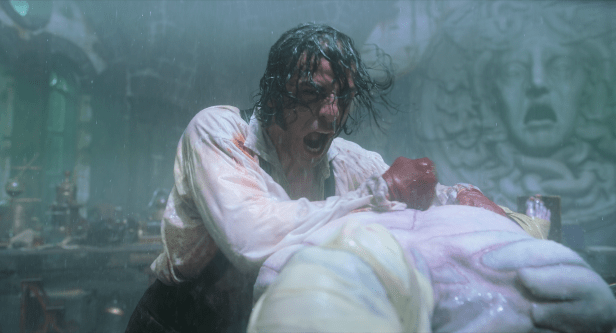
And then there’s Mia Goth, who gives one of the most arresting performances in the entire film. There’s something otherworldly about the way she moves through del Toro’s world — ethereal yet razor-sharp, fragile yet unyielding. Goth has always excelled at playing women suspended between vulnerability and violence, but here she reaches a new level of precision and magnetism. I couldn’t take my eyes off her. The chemistry between all three of them is electric.
The moment with the leaf — simple, delicate, and devastating — is one of the most powerful moments in the entire film.

Now streaming on Netflix, I genuinely cannot emphasize enough just how extraordinary this film is. Del Toro hasn’t merely reimagined Frankenstein.
He’s resurrected it — and given it a soul.
There will be more film reviews soon so…
Stay Tuned!
 Life In Cartoon Motion